The end of geographic immunity
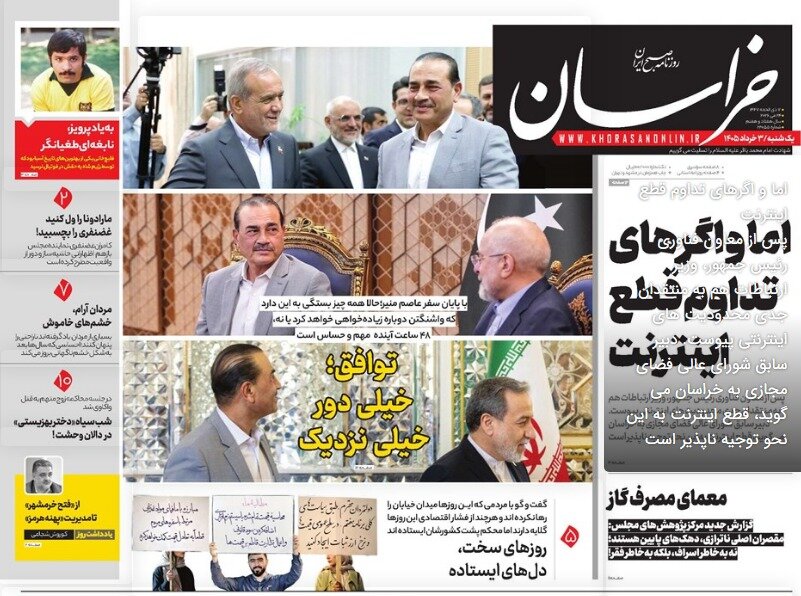
Khorasan addressed the IRGC’s recent statement and wrote: The IRGC’s recent declaration about extending the war beyond the region marks an official shift from a traditional defensive doctrine to a strategy of expansive offensive deterrence. For the United States, the IRGC’s warning is the final blow to the theory of fighting wars far from its borders.
Today, officials in the White House understand that their military bases across the world, their economic interests in Latin America and Africa, and even their cyber‑infrastructure inside the US homeland are all within reach of Iran’s missiles and its non‑state allies. The West now stands at a historic crossroads: either submit to on‑the‑ground realities or embark on an adventure that could deal a fatal blow to the economy and security of Western societies. What is certain is that the era of American and European dominance and self‑immunization has ended, and this time the region—now from a position of strength—will be the final arbiter of peace or global war.
Donya‑e‑Eqtesad: Iran and the US in a resilience race
Donya‑e‑Eqtesad analyzed the possibility—or impossibility—of a diplomatic solution. The analysis states: What is being described as a “diplomatic solution” is in fact only a temporary framework to prevent further escalation until a concrete diplomatic agreement is reached. Therefore, it appears that we remain far from resolving the fundamental disputes between Iran and the United States—namely, the reopening of the Strait of Hormuz and the issue of 60‑percent enriched uranium. For this reason, it cannot be said that military action has been removed from Trump’s agenda. In reality, both sides have entered a contest of endurance. Iran believes that Trump cannot keep US forces in the region for long and will eventually be forced to retreat. Trump believes that if he fails to escape this credibility trap, his position on the international stage—and the broader competition among great powers—will be negatively affected.
Arman‑e‑Melli: Time is working against the United States
Arman‑e‑Melli argued that the passage of time in the current situation harms Trump and wrote: Trump is trapped in a tight corner, still imagining that through repetitive psychological warfare he can pressure Iran—politically and psychologically—into granting concessions that he could then present as an achievement to the American public. It must be acknowledged that the gap between Iran’s demands and America’s coercive policies is vast, and there is no statement or signal from the American side indicating a willingness to accept the realities and capabilities of the Islamic Republic after the recent aggression. In the past, during negotiations, time always worked against Iran, and the US government tried to pressure Iran by setting deadlines. But now time is working against the United States, and the necessity of reaching an agreement will not remain distant. Ultimately, the two sides may be able to reach a point of equilibrium that enables an agreement.
Resalat: A structural shift in the international system
The consolidation of a new balance of power in West Asia, the decline of US hegemony, and the Trump administration’s helplessness in the face of the steadfast will of the Islamic Resistance—these months have witnessed one of the most important, complex, and decisive turning points in the geopolitical equations of West Asia and even the overall structure of the international system. It can be said with confidence that the most humiliating, strategic, and disgraceful defeat for the Trump administration in this unprecedented confrontation has been Iran’s firm assertion of sovereignty and decisive control over the strategic Strait of Hormuz. In a legitimate response to US military aggression and state terrorism by the United States and Israel, Iran, with full strategic intelligence and by exercising its legal right to defend territorial integrity and employ powerful geopolitical leverage, closed this vital waterway to aggressors and their supporters. With this bold action, it effectively paralyzed the energy supply chain of the hegemonic powers.
Hamshahri: Trump’s new policy; threats in a dead end
Hamshahri, in an article examining the crisis and Trump’s approach, quoted regional affairs expert Seyyed Reza Sadr‑al‑Hosseini: Trump, in a situation where time is severely working against him, seeks to obtain—through political deception and by creating division and fragmentation among the public—what he failed to achieve on the battlefield. He aims to use contradictions and threats, amplified by media outlets that widely broadcast his statements, to disrupt the cognitive processes of Iranian officials and push them—through intimidation—toward fulfilling his needs. These actions come at a time when his own party’s critics have recently questioned his performance and statements, intensifying political pressure on him. Yet Trump still intends to continue this situation—one in which he himself is the primary loser—by keeping the machinery of rumor‑mongering, threats, and intimidation running.
Leave a Comment